
Over the past decade, pant style baby diapers have fundamentally reshaped infant care across global markets. What began as a niche convenience product has evolved into a dominant format within the disposable hygiene category. Today, pant style diapers influence not only consumer purchasing behavior but also manufacturing investments, retail assortments, and brand strategies worldwide.
As the global personal care ecosystem matures, caregivers increasingly seek solutions that align with modern lifestyles, prioritizing speed, comfort, and mobility. The rapid adoption of pant, style baby diapers reflects more than a product upgrade; it signals deeper shifts in parenting norms, caregiver expectations, and diaper manufacturing innovation.
What Are Pant, Style Baby Diapers?
Pant style baby diapers, commonly referred to as pull, up diapers, are designed to be worn like underwear, eliminating the need for side tapes or fastening tabs. By combining the absorbency performance of traditional diapers with the simplicity and comfort of elasticized underwear, these products are particularly well suited for active babies and toddlers.
Their intuitive pull, on design makes them especially popular during the transition phase toward potty training, when ease of movement and independence become key considerations for both children and caregivers.
Global Baby Diaper Market: Size, Trends, and Growth
The global baby diaper market has demonstrated consistent resilience and expansion. Industry estimates place the worldwide baby diaper market at approximately USD 70.6 billion in 2023, with forecasts projecting growth at a compound annual growth rate of around 5.9% through 2030.
This sustained baby diaper market growth is driven by a combination of factors: urbanization, rising disposable incomes, improving hygiene awareness, and evolving childcare standards across both developed and emerging economies.
Within this broader expansion, pant, style baby diapers are growing faster than tape, style alternatives, largely due to lifestyle, driven preferences and rising expectations around convenience and performance.
Why Pant, Style Baby Diapers Are Gaining Market Leadership
1. Ease of Use and Caregiver Convenience
One of the most decisive factors behind the rise of pant style baby diapers is speed and simplicity. Parents can pull them on and off in seconds, without adjusting tabs or struggling with fit, an invaluable advantage when changing an active or uncooperative toddler.
This ease of use has made pant diapers the preferred choice for day, care settings, travel, and on, the, go parenting.
2. Improved Fit for Active Toddlers
Pant, style diapers are engineered to move with the child. Elastic waistbands and stretchable side panels ensure a secure fit during crawling, walking, and play. Compared to tape, style diapers, pant diapers are less likely to shift out of place, resulting in fewer leaks and greater overall comfort, particularly for older infants.
3. Seamless Potty-Training Transition
Pant diapers play a strategic role in potty training. Their underwear, like design helps toddlers become familiar with pulling garments up and down, supporting both psychological readiness and practical learning.
For parents, pant diapers act as a natural bridge between diapers and regular underwear, reducing friction during this transition phase.
4. Material Innovation and Product Enhancements
Advancements in diaper technology have further strengthened consumer preference. Modern pant diapers feature ultra, breathable outer layers, high, stretch waistbands, advanced absorbent cores, wetness indicators, and reinforced leak guards.
These improvements have elevated comfort standards and strengthened brand differentiation within a competitive market.
Baby Diaper Market Trends Shaping the Future
The strong momentum behind pant, style diapers mirrors several broader baby diaper market trends:
Premiumization: Parents increasingly invest in products that offer superior fit, softness, and skin protection.
Sustainability Focus: While disposable diapers remain dominant, manufacturers are integrating eco, conscious materials and more efficient designs.
E, commerce Expansion: Online retail has accelerated access to premium diaper formats, boosting pant, style adoption.
Customization and Private Labeling: Retailers are launching private label baby diapers to balance brand loyalty with price sensitivity.
Manufacturing Ecosystem: India’s Expanding Role
Baby Diaper Manufacturing in India
India has emerged as a critical hub in the global diaper supply chain. Competitive labor costs, a well, developed textile and non, woven materials ecosystem, and rising export demand have positioned the country as a preferred manufacturing base.
Industry reports suggest that India’s diaper production capacity has nearly quadrupled over the past decade, supplying both domestic markets and exports to Africa, the Middle East, and Southeast Asia.
Export Growth and Global Reach
Baby diaper exports from India have increased steadily as manufacturers integrate with global logistics networks. Competitive pricing and improving quality standards have strengthened India’s appeal in markets seeking cost, effective alternatives to established Western brands.
Pant, Style Diaper Demand Across Regions
The growth of pant style diaper demand spans both mature and emerging markets:
North America and Europe: High adoption driven by convenience, premium positioning, and established retail infrastructure.
Asia, Pacific: Rapid expansion supported by urbanization, rising middle, class incomes, and caregiver education.
Latin America and MENA: Growing accessibility and affordability are expanding the consumer base.
In several regions, pant diapers now account for 40, 60% of total diaper unit sales, a significant increase compared to a decade ago.
Manufacturing Realities: Processes and Challenges
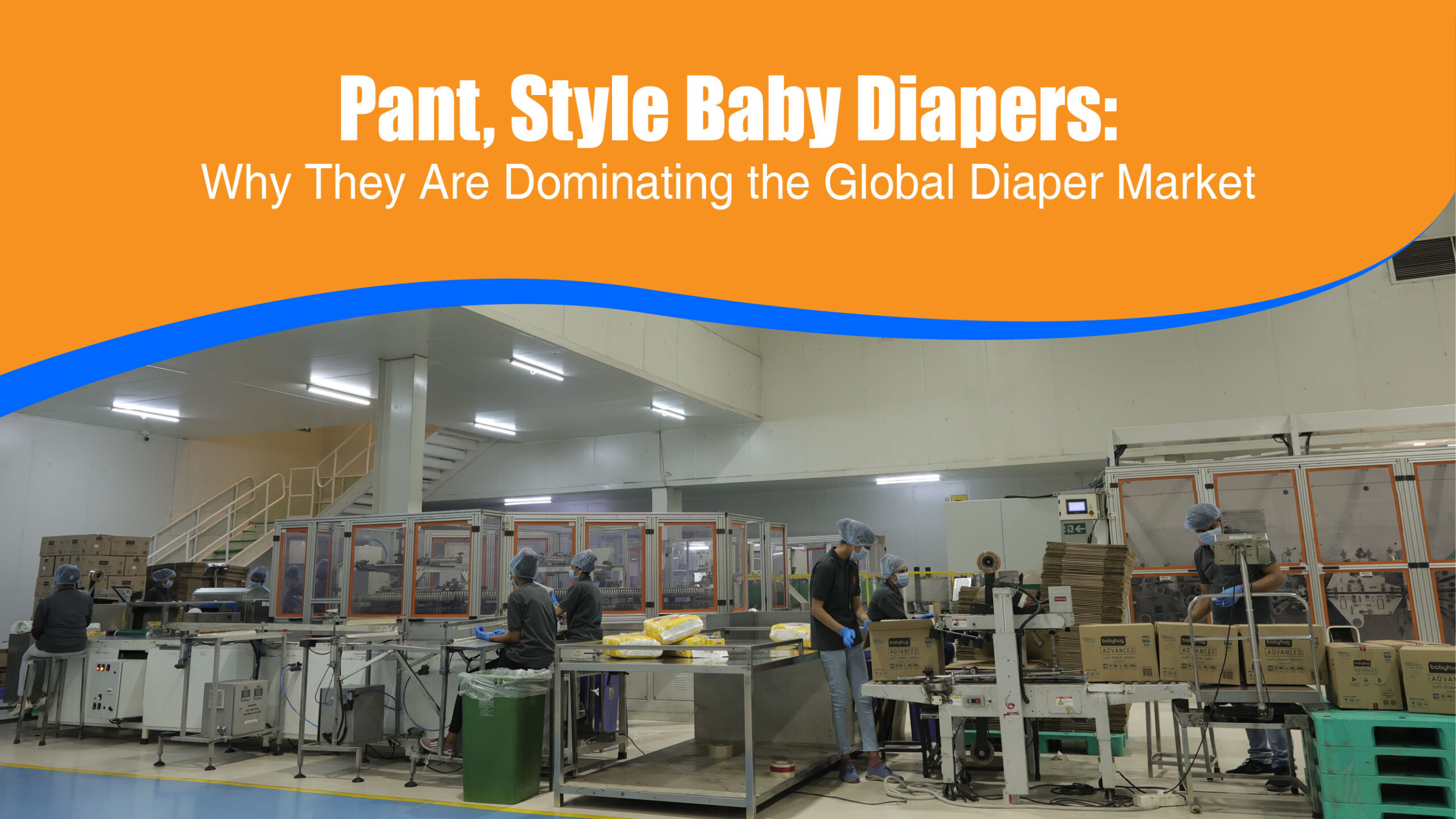
The pant diaper manufacturing process requires specialized, high, speed machinery and precise engineering. Key stages include:
- Non, woven fabric layering
- Elastic waistband integration
- Leak, proof absorbent core assembly
- Automated cutting and sealing
To remain competitive at scale, manufacturers rely on high, speed production lines capable of consistent output and quality.
Key Challenges.
- Maintaining uniform quality across large production volumes
- Managing costs without compromising absorbency or comfort
- Securing stable supply chains for SAP and elastic materials
Advantages of Pant, Style Baby Diapers
For caregivers, pant, style diapers offer clear benefits:
- Faster, stress, free diaper changes
- Improved fit with reduced skin irritation
- Greater freedom of movement for children
- Smoother potty training transitions
From a commercial standpoint, brands with strong pant, style portfolios often achieve higher consumer retention and stronger shelf preference.
Conclusion
The rise of pant style baby diapers reflects a decisive shift in caregiving expectations, product innovation, and global manufacturing priorities. As parents demand greater convenience, mobility, and comfort, pant, style designs have moved from an alternative format to the preferred standard.
Supported by sustained baby diaper market growth, expanding baby diaper manufacturing in India, and strong global adoption, pant, style diapers are not a passing trend, they are shaping the future of disposable infant care worldwide.
FAQ’s
What are pant, style baby diapers?
Pull, up diapers designed like underwear, offering convenience and flexibility over tape, style diapers.
Why are pant, style diapers more popular than tape, style diapers?
They are easier to use, fit active babies better, and suit older infants and toddlers.
Are pant, style diapers better for babies?
For older infants and toddlers, they offer enhanced comfort and mobility without sacrificing absorbency.
Which regions show the highest demand?
North America and Western Europe lead, followed closely by Asia, Pacific.
What age group primarily uses pant diapers?
Typically babies aged 8, 24 months and toddlers during potty training.
How are pant, style diapers manufactured?
Through multilayer assembly using non, woven fabrics, absorbent cores, elastics, and automated sealing.
Are pant diapers more expensive to produce?
Slightly, due to advanced fit features, but higher retail pricing often offsets costs.
What benefits do parents value most?
Ease of use, better fit, fewer leaks, and convenience.
Can brands offer pant diapers through private labeling?
Yes. Many manufacturers support private label baby diapers with customized specifications.
Why is India a major diaper manufacturing hub?
Manufacturing scale, export infrastructure, and competitive cost structures drive India’s growth.


