
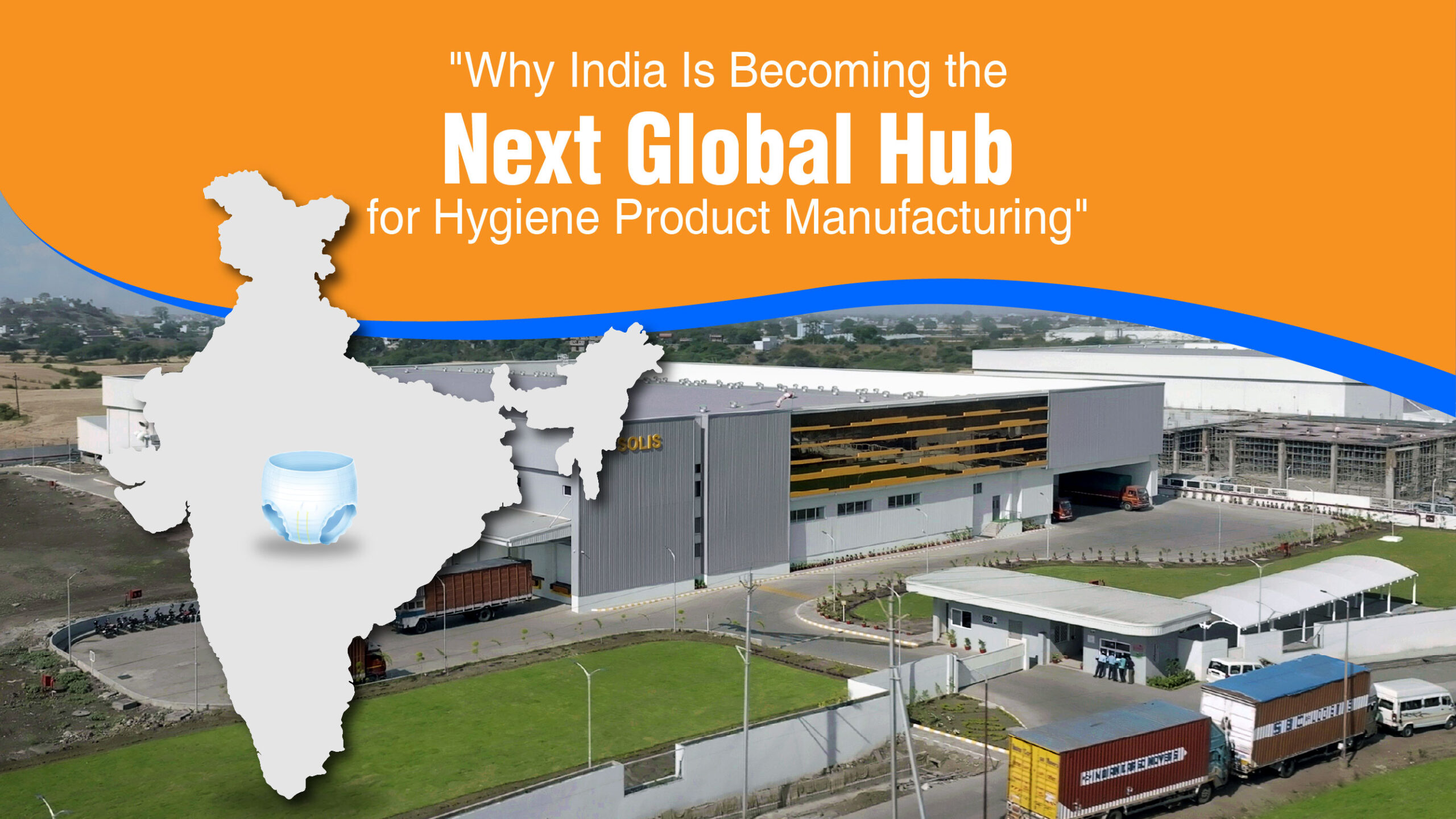
India’s rise as a hygiene product manufacturing powerhouse is no longer an emerging trend—it is an established reality. Over the past decade, the country has positioned itself as a reliable, scalable, and quality-driven hub for producing diapers, sanitary pads, adult incontinence products, wet wipes, and private-label hygiene lines for global markets. From a strong domestic consumption base to world-class converting machinery and cost-efficient operations, India is steadily strengthening its role in the global hygiene supply chain.
Table of Contents
This shift is visible across the industry: high-speed converting lines installed in Indian factories, the expansion of nonwoven and technical-textile capacity, the rapid growth of contract manufacturers, and the rising volume of exports to the Middle East, Africa, Southeast Asia, and Latin America. As global brands and retail chains diversify their supply networks, India is increasingly seen as a dependable, future-ready hub for hygiene production.
Why India Has Become a Preferred Destination for Hygiene Manufacturing
The question of why hygiene products are increasingly manufactured in India can be answered through a set of tangible, structural advantages already in place.
India holds one of the world’s largest consumer markets for baby diapers, sanitary pads, and wipes, enabling manufacturers to operate at high volumes year-round—an essential ingredient for competitive unit economics. Alongside demand, the country has seen significant growth in its technical-textile and nonwoven sectors, aided by government initiatives under the Ministry of Textiles to scale domestic production of hygiene-grade materials.
Labour cost competitiveness remains a major strength. At the same time, India benefits from a skilled workforce familiar with global converting machines used in diaper and sanitary-pad manufacturing. This combination of capability and cost efficiency creates an environment where global-scale hygiene production is not only feasible but commercially advantageous.
Contract Manufacturing: The Engine Behind India’s Hygiene Boom
A large portion of India’s rise stems from its thriving contract manufacturing ecosystem. Today, India is home to a diverse network of OEMs producing baby diapers, adult diapers, maternity pads, pantyliners, and wet wipes for private-label brands, retail chains, and importers across multiple continents.
These OEMs offer far more than assembly. They support clients with:
- Product formulation
- Tooling and prototyping
- Packaging development
- Compliance documentation
- Export logistics
This end-to-end capability positions India alongside leading OEM regions such as China, Turkey, and Indonesia—making it one of the most complete hygiene manufacturing ecosystems in the world.
How India Became a Diaper OEM Export Hub
India’s emergence as a diaper OEM export hub is driven largely by strong and consistent demand from the Middle East, Africa, and Southeast Asia. These regions rely heavily on imported diapers and adult-care products, and Indian factories offer the right balance of quality, customization, and cost efficiency.
Export buyers choose India for:
- Competitive pricing
- Ability to customize SKUs, designs, and packaging
- Efficient shipping routes to GCC, Africa, and Southeast Asia
- Strong compliance documentation (CE, ISO, SASO, etc.)
- Flexible production of both pant-style and tape-style diapers
With established export corridors and a growing reputation for reliability, India has become a preferred sourcing base for global distributors and importers.
India’s Cost Advantage in Hygiene Manufacturing
One of India’s biggest strengths lies in the cost structure of hygiene product manufacturing. Affordable labour, expanding local nonwoven supply, mature packaging industries, and high-volume production capacity enable Indian factories to deliver competitive unit costs without compromising on quality.
Manufacturers commonly source critical raw materials—SAP, breathable backsheet film, elastics, hot-melt adhesives—from globally recognized suppliers. This allows Indian OEMs to maintain international hygiene standards while preserving the cost efficiencies that global buyers seek.
For B2B customers looking for consistency, India’s blend of affordability and manufacturing capability is a compelling advantage.
India’s Expanding Role in the Global Hygiene Supply Chain
India’s role in the global supply chain for adult and baby diaper manufacturing continues to grow. Today, Indian manufacturers supply large volumes of retail SKUs to global wholesalers, distributors, NGOs, and private-label brands. Adult incontinence products represent a particularly fast-growing category. Indian factories now produce a wide range of adult pant-style briefs, tape-style diapers, and underpads for export, helping global buyers diversify sourcing and reduce reliance on a limited number of markets. India’s hygiene industry is no longer just supplying domestic consumers—it is increasingly powering the shelves of international retailers.
Why India Holds a Competitive Edge in Hygiene Production
India’s competitive advantage is rooted in a blend of operational maturity and supply-chain capability. The country now benefits from:
- A skilled workforce with expertise in hygiene converting technology
- Expanded nonwoven and technical-textile production capacity
- Advanced, automated converting lines across major factories
- A strong packaging and printing industry
- Government-supported export systems
- Strategic proximity to major hygiene-importing regions such as GCC, East Africa, and South Africa
These strengths give India a practical, grounded advantage—not speculative or futuristic, but already in motion.
What It Takes to Win in India’s Hygiene Product Manufacturing Ecosystem
To succeed in India’s hygiene product manufacturing rapidly expanding OEM and contract manufacturing environment, companies must focus on five core pillars:
1. Strong Compliance & Documentation
Buyers expect ISO certifications, GMP standards, hygiene-product traceability, and clear quality protocols.
2. Material Reliability
Consistent access to nonwovens, elastics, SAP, and films is essential for dependable output.
3. Export Readiness
Understanding regulatory documentation for key markets—including Europe, UAE, GCC, Africa, and the U.S.—is crucial.
4. Format Flexibility
Manufacturers offering multiple formats—pant diapers, tape diapers, sanitary pads, adult diapers—gain an advantage in OEM negotiations.
5. Clear & Transparent Communication
Global B2B customers expect alignment on pricing, MOQs, production capacity, and lead times.
With these capabilities, India isn’t just participating in global hygiene supply chains—it is shaping them. As demand grows and OEM networks expand, India is rapidly solidifying its status as a global hub for hygiene Product manufacturing for the decade ahead.